About
Overview of the Comparative Planning Service:
Proton beam therapy (PBT) is a type of radiation that uses high-energy protons to kill cancer cells. This is different to conventional radiation therapy in Australia that uses x-rays.
While PBT is not yet available in Australia, Australian patients wishing to access this form of treatment can apply for Federal Government funding through the Medical Treatment Overseas Program (MTOP). You need to meet all the eligibility requirements, as set out by MTOP, to be approved for PBT overseas.
This may or may not require a comparative plan. Please refer to the MTOP website for further information https://www.health.gov.au/our-work/medical-treatment-overseas-program
Comparative treatment planning is a process in which the radiation dose of a conventional x-ray radiation therapy (XRT) treatment plan is compared with that of a PBT treatment plan. By reviewing and comparing the distribution of radiation dose between the two plans, the potential clinical benefit, or otherwise, of PBT can be assessed.
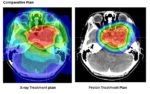
There are many different types of radiation that are used in different scenarios. PBT is not suitable for all types of cancers or patients.
There is no cost for patients (or family) for a comparative plan.
The ABCPTR comparative planning team consists of highly skilled, trained professionals including radiation therapists, medical physicists and radiation oncologists.
Aim:
- Produce PBT plans in a timely manner for patients where a clinical benefit may be predicted from PBT
- Provide factual information to the referring oncologist on the comparison between an XRT plan and PBT plan.
- Foster national collaboration and learning to ensure all patients who are likely to benefit from PBT have access to this treatment
Data Collection
Data will be collected from patients referred to the ABCPTR comparative planning service. This information will be recorded directly onto the REDCap database from the electronic referral form completed by clinicians when referring a patient to the comparative planning service.
The data collected will include:
- Basic patient demographics
- Diagnosis
- Digital Imaging and Communications in Medicine (DICOM) files for the radiation therapy planning CT scan and any other scans used for planning.
Ownership of Data and Intellectual Property:
A patients’ XRT planning data sent to the ABCPTR as part of the referral for a comparative plan will remain the property of the referring institution and patient. The ABCPTR will retain a copy of the XRT planning data for its records.
The patient’s treating radiation oncologist is responsible for the referral to ABCPTR for a comparative plan and obtaining consent from the patient for their DICOM data to be transferred.
Upon receipt of this referral, the ABCPTR comparative planning service will email the patient for their consent to their data being used for research purposes.
PBT plans are produced for demonstrative purposes and are not to be used for treatment.